© 2024 Daniel F. Ruiz, Exneyder A. Montoya-Araque y Universidad EAFIT.
This notebook can be interactively run in Google - Colab.
This notebook runs the model pyNermarkDisp developed by Montoya-Araque et al. (2024) based on the classical sliding rigid block method by Newmark (1965).
Required modules and global setup for plots
import os
import sys
import subprocess

if 'google.colab' in str(get_ipython()):
    print('Running on CoLab. Installing the required modules...')
    # subprocess.run('pip install ipympl', shell=True);
    subprocess.run('pip install pynewmarkdisp', shell=True);
    from google.colab import output, files
    output.enable_custom_widget_manager()
else:
    import tkinter as tk
    from tkinter.filedialog import askopenfilename

import numpy as np
import pandas as pd
import matplotlib as mpl
import matplotlib.pyplot as plt
from pynewmarkdisp.newmark import direct_newmark, plot_newmark_integration
from pynewmarkdisp.infslope import factor_of_safety, get_ky

# %matplotlib widget
%matplotlib inline
mpl.rcParams.update({
    "font.family": "serif",
    "font.serif": ["Computer Modern Roman", "cmr", "cmr10", "DejaVu Serif"],  # or
    "mathtext.fontset": "cm",  # Use Computer Modern fonts for math
    "axes.formatter.use_mathtext": True,  # Use mathtext for axis labels
    "axes.unicode_minus": False,   # Use standard minus sign instead of a unicode character
})

# Create a folder where the records will be saved
workdir = os.getcwd()
records_dir = os.path.join(workdir, "records")
os.makedirs(f"{records_dir}", exist_ok=True)Functions
def load_file(testing_data):
    if testing_data:
        url = "https://raw.githubusercontent.com/eamontoyaa/data4testing/main/pynewmarkdisp/"
        # record = np.loadtxt(f"{url}earthquake_data_friuli.csv", delimiter=";", skiprows=1)
        # record[:, 1] = - 2.0 * 9.81 * record[:, 1]  # Convert to SI units
        record = np.loadtxt(f"{url}earthquake_data_armenia1999.csv", delimiter=",")
    elif testing_data is False and 'google.colab' in str(get_ipython()):
        file = files.upload()
        # Move the file to the records folder
        os.rename(list(file.keys())[0], os.path.join(records_dir, list(file.keys())[0]))
        record = np.loadtxt(os.path.join(records_dir, list(file.keys())[0]))#, delimiter=",")
    else:  # GUI for file selection from local machine if not in CoLab
        tk.Tk().withdraw() # part of the import if you are not using other tkinter functions
        file = askopenfilename()
        # Move the file to the records folder
        os.rename(file, os.path.join(records_dir, os.path.basename(file)))
        record = np.loadtxt(os.path.join(records_dir, os.path.basename(file)))
    time, accel = record.T
    return time, accel

def get_arias_intensity(time, accel, g):
    return np.trapz(y=accel**2, x=time) * np.pi / (2 * g)

def get_pgv(time, accel, g):
    accel = 9.81 * accel / g  # Earthquake acceleration to SI units
    vel = np.cumsum(accel) * (time[1] - time[0])
    return np.max(np.abs(vel))

def get_pga(accel, g):
    return np.max(np.abs(accel / g))
Running a case
testing_data = True # Set to False to use the GUI to load the data from an external fileInputs (conditioning factors)
# Geometry
β = 35  # [°] - Slope angle - Plane inclination
d = 3.0  # [m] - Depth of the slip surface - Block height
d_w = 3.0  # [m] - Depth of the water table

# Material parameters
φ = 27  # [°] - Friction angle
c = 15  # [kPa] - Cohesion
γ = 19  # [kN/m³] - Unit weight
Inputs (triggering factor - Earthquake record)
time, accel = load_file(testing_data)
time, accel
(array([0.0000e+00, 5.0000e-03, 1.0000e-02, ..., 3.4985e+01, 3.4990e+01,
3.4995e+01]),
array([0.00246051, 0.00246493, 0.00246935, ..., 0.02309875, 0.05239547,
0.08169219]))# Value of gravity acceleration in the same units as in the earthquake record
# g = 1.0 # → It means that acceleration units in the input file are given in [g]
g = 9.81 # → It means that acceleration units in the input file are given in [m/s²]
# g = 981 # → It means that acceleration units in the input file are given in [cm/s²]PGA = get_pga(accel, g)
print(f"PGA: {PGA:.2f} g")PGA: 0.54 g
Static factor of safety, 
fs = factor_of_safety(d, d_w, β, φ, c, γ, ks=0)
print(f"Static factor of safety: {fs:.2f}")
Static factor of safety: 1.29
Critical seismic coefficient 
ky = get_ky(d, d_w, β, φ, c, γ)
print(f"Critical seismic coefficient, ky: {ky:.2f}")
Critical seismic coefficient, ky: 0.15
Pseudo-static factor of safety, , when is 70% of 
ks = 0.7 * ky
fs_ks = factor_of_safety(d, d_w, β, φ, c, γ, ks)
print(f"Seismic coefficient, ks: {ks:.3f}")
print(f"Pseudostatic factor of safety: {fs_ks:.2f}")

decrease_fs = (fs - fs_ks) / fs * 100
print(f"Decrease in factor of safety: {decrease_fs:.2f} %")
Seismic coefficient, ks: 0.104
Pseudostatic factor of safety: 1.07
Decrease in factor of safety: 16.54 %
Pseudo-static factor of safety, , when is 50% of PGA
ks = 0.5 * PGA
fs_ks = factor_of_safety(d, d_w, β, φ, c, γ, ks)
print(f"Seismic coefficient, ks: {ks:.3f}")
print(f"Pseudostatic factor of safety: {fs_ks:.2f}")

decrease_fs = (fs - fs_ks) / fs * 100
print(f"Decrease in factor of safety: {decrease_fs:.2f} %")
Seismic coefficient, ks: 0.270
Pseudostatic factor of safety: 0.83
Decrease in factor of safety: 35.56 %
Calculating and plotting 
permanent_disp = direct_newmark(time, accel, ky, g)
# permanent_disp = direct_newmark(time, accel, .135, g)
fig = plot_newmark_integration(permanent_disp)
fig.canvas.header_visible = False
fig.canvas.toolbar_position = 'bottom'
plt.show()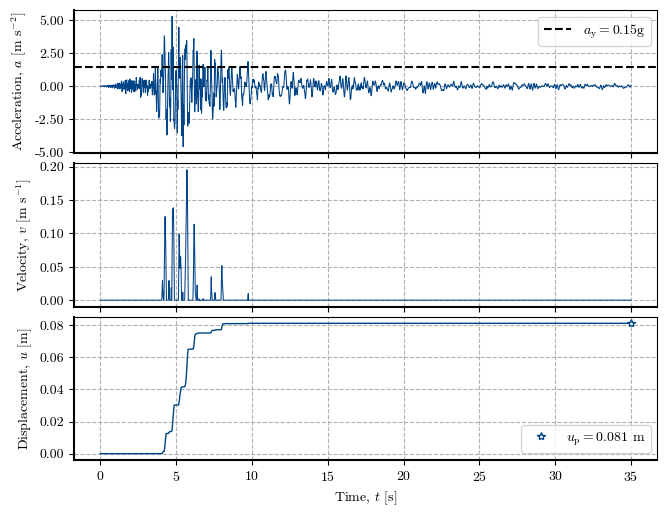
- Montoya-Araque, E. A., Montoya-Noguera, S., & Lopez-Caballero, F. (2024). An open-source application software for spatial prediction of permanent displacements in earthquake-induced landslides by the Newmark sliding block method: pyNewmarkDisp. Environmental Modelling & Software, 173, 105942. 10.1016/j.envsoft.2024.105942
- Newmark, N. M. (1965). Effects of Earthquakes on Dams and Embankments. Géotechnique, 15(2), 139–160. 10.1680/geot.1965.15.2.139