© 2024 Daniel F. Ruiz, Exneyder A. Montoya-Araque y Universidad EAFIT.
This notebook can be interactively run in Google - Colab.
This notebook runs the model TRIGRS (Transient Rainfall Infiltration and Grid-Based Regional Slope-Stability Analysis), developed by Baum et al. (2002) and Baum et al. (2008), and parallelized later by Alvioli & Baum (2016)
Required modules and global setup for plots
import os
import subprocess
import textwrap
import itertools
import requests

import numpy as np
import pandas as pd
import matplotlib.pyplot as plt
import matplotlib as mpl
from IPython import get_ipython
from IPython.display import display

if 'google.colab' in str(get_ipython()):
    print('Running on CoLab. Installing the required modules...')
    # subprocess.run('pip install ipympl', shell=True);
    from google.colab import output, files
    output.enable_custom_widget_manager()
else:
    import tkinter as tk
    from tkinter.filedialog import askopenfilename

# Figures setup
# %matplotlib widget
mpl.rcParams.update({
    "font.family": "serif",
    "font.serif": ["Computer Modern Roman", "cmr", "cmr10", "DejaVu Serif"],  # or
    "mathtext.fontset": "cm",  # Use Computer Modern fonts for math
    "axes.formatter.use_mathtext": True,  # Use mathtext for axis labels
    "axes.unicode_minus": False,   # Use standard minus sign instead of a unicode character
})
Creating directories
# Create a folder called TRIGRS in the current working directory if it doesn't exist
workdir = os.getcwd()
exec_dir = os.path.join(workdir, "TRIGRS_1")
os.makedirs(f"{exec_dir}", exist_ok=True)

# Create a folder inside TRIGRS to store the ascii files
inputs_dir = os.path.join(exec_dir, "inputs")
outputs_dir = os.path.join(exec_dir, "outputs")
os.makedirs(f"{inputs_dir}", exist_ok=True)
os.makedirs(f"{outputs_dir}", exist_ok=True)Functions
def tpx_in_maker(tpx_inputs):
    tpx_in_template = textwrap.dedent(
        f"""\
        TopoIndex 1.0.15; Name of project (up to 255 characters)
        TopoIndex analysis - Project: {tpx_inputs["proj_name"]}
        Flow-direction numbering scheme (ESRI=1, TopoIndex=2)
        {tpx_inputs["flow_dir_scheme"]}
        Exponent, Number of iterations
        {tpx_inputs["exponent_weight_fact"]}, {tpx_inputs["iterarions"]}
        Name of elevation grid file
        TRIGRS_1/inputs/dem.asc
        Name of direction grid
        TRIGRS_1/inputs/directions.asc
        Save listing of D8 downslope neighbor cells (TIdsneiList_XYZ)?  Enter T (.true.) or F (.false.)
        T
        Save grid of D8 downslope neighbor cells (***TIdscelGrid_XYZ)? Enter T (.true.) or F (.false.)
        T
        Save cell index number grid (TIcelindxGrid_XYZ)?  Enter T (.true.) or F (.false.)
        T
        Save list of cell number and corresponding index number (***TIcelindxList_XYZ)? Enter T (.true.) or F (.false.)
        T
        Save flow-direction grid remapped from ESRI to TopoIndex (TIflodirGrid_XYZ)? Enter T (.true.) or F (.false.)
        T
        Save grid of points on ridge crests (TIdsneiList_XYZ)? Enter T (.true.) or F (.false.); Sparse (T) or dense (F)?
        F,T
        ID code for output files? (8 characters or less)
        {tpx_inputs["proj_name"]}"""
    )
    with open("tpx_in.txt", "w") as file:
        file.write(tpx_in_template)
    return


def run_topoidx(tpx_inputs):
    tpx_in_maker(tpx_inputs)  # Generating initializing files
    subprocess.call(["chmod +x ./TRIGRS_1/Exe_TopoIndex"], shell=True)  # Change permission
    subprocess.call(["./TRIGRS_1/Exe_TopoIndex"])  # Running Fortran executable
    # Moving log file to outputs folder and renaming it
    os.rename(os.path.join(workdir, "TopoIndexLog.txt"), os.path.join(outputs_dir, f"TopoIndexLog_{tpx_inputs['proj_name']}.txt"))
    os.rename(os.path.join(workdir, "tpx_in.txt"), os.path.join(exec_dir, f"tpx_in_{tpx_inputs['proj_name']}.txt"))
    return


def tr_in_maker(trg_inputs):
    # Create text block for geotechnical parameters of each zone
    geoparams = ""
    for zone in trg_inputs["geoparams"].keys():
        z = trg_inputs["geoparams"][zone]
        # print(zone, z)
        txt_zone = "".join(
            [
                f"zone, {zone}\n",
                "cohesion, phi, uws, diffus, K-sat, Theta-sat, Theta-res, Alpha\n",
                f'{z["c"]}, {z["φ"]}, {z["γ_sat"]}, {z["D_sat"]}, {z["K_sat"]}, {z["θ_sat"]}, {z["θ_res"]}, {z["α"]}\n',
            ]
        )
        geoparams = str().join([geoparams, txt_zone])
    # Update rifil entry with placeholder for each file
    trg_inputs["rifil"] = str().join(
        [f"TRIGRS_1/inputs/ri{n}.asc\n" for n in range(1, len(trg_inputs["capt"]))]
    )

    # Template
    trg_in_template = (
        textwrap.dedent(
            f"""\
        Project: {trg_inputs['proj_name']}
        TRIGRS, version 2.1.00c, (meter-kilogram-second-degrees units)
        tx, nmax, mmax, zones
        {trg_inputs['tx']}, {trg_inputs['nmax']}, {trg_inputs['mmax']}, {trg_inputs['zones']}
        nzs, zmin, uww, nper t
        {trg_inputs['nzs']}, 0.001, 9.8e3, {trg_inputs['nper']}, {trg_inputs['t']}
        zmax, depth, rizero, Min_Slope_Angle (degrees), Max_Slope_Angle (degrees)
        {trg_inputs['zmax']}, {trg_inputs['depth']}, {trg_inputs['rizero']}, 0., 90.0
        """
        )
        + geoparams[:-1]
        + textwrap.dedent(
            f"""
        cri(1), cri(2), ..., cri(nper)
        {', '.join(map(str, trg_inputs['cri']))}
        capt(1), capt(2), ..., capt(n), capt(n+1)
        {', '.join(map(str, trg_inputs['capt']))}
        File name of slope angle grid (slofil)
        TRIGRS_1/inputs/slope.asc
        File name of digital elevation grid (elevfil)
        TRIGRS_1/inputs/dem.asc
        File name of property zone grid (zonfil)
        TRIGRS_1/inputs/zones.asc
        File name of depth grid (zfil)
        TRIGRS_1/inputs/zmax.asc
        File name of initial depth of water table grid   (depfil)
        TRIGRS_1/inputs/depthwt.asc
        File name of initial infiltration rate grid   (rizerofil)
        TRIGRS_1/inputs/rizero.asc
        List of file name(s) of rainfall intensity for each period, (rifil())
        """
        )
        + trg_inputs["rifil"][:-2]
        + textwrap.dedent(
            f"""
        File name of grid of D8 runoff receptor cell numbers (nxtfil)
        TRIGRS_1/inputs/TIdscelGrid_{trg_inputs['proj_name']}.txt
        File name of list of defining runoff computation order (ndxfil)
        TRIGRS_1/inputs/TIcelindxList_{trg_inputs['proj_name']}.txt
        File name of list of all runoff receptor cells  (dscfil)
        TRIGRS_1/inputs/TIdscelList_{trg_inputs['proj_name']}.txt
        File name of list of runoff weighting factors  (wffil)
        TRIGRS_1/inputs/TIwfactorList_{trg_inputs['proj_name']}.txt
        Folder where output grid files will be stored  (folder)
        TRIGRS_1/outputs/
        Identification code to be added to names of output files (suffix)
        {trg_inputs['proj_name']}
        Save grid files of runoff? Enter T (.true.) or F (.false.)
        F
        Save grid of minimum factor of safety? Enter T (.true.) or F (.false.)
        T
        Save grid of depth of minimum factor of safety? Enter T (.true.) or F (.false.)
        T
        Save grid of pressure head at depth of minimum factor of safety? Enter T (.true.) or F (.false.)
        T
        Save grid of computed water table depth or elevation? Enter T (.true.) or F (.false.) followed by 'depth,' or 'eleva'
        T, depth
        Save grid files of actual infiltration rate? Enter T (.true.) or F (.false.)
        F
        Save grid files of unsaturated zone basal flux? Enter T (.true.) or F (.false.)
        F
        Save listing of pressure head and factor of safety ("flag")? (-9 sparse xmdv , -8 down-sampled xmdv, -7 full xmdv, -6 sparse ijz, -5 down-sampled ijz, -4 full ijz, -3 Z-P-Fs-saturation list -2 detailed Z-P-Fs, -1 Z-P-Fs list, 0 none). Enter flag value followed by down-sampling interval (integer).
        {trg_inputs['ψ_flag']}, {trg_inputs['nzs']}
        Number of times to save output grids and (or) ijz/xmdv files
        {trg_inputs['n_outputs']}
        Times of output grids and (or) ijz/xmdv files
        {', '.join(map(str, trg_inputs['t_n_outputs']))}
        Skip other timesteps? Enter T (.true.) or F (.false.)
        F
        Use analytic solution for fillable porosity?  Enter T (.true.) or F (.false.)
        T
        Estimate positive pressure head in rising water table zone (i.e. in lower part of unsat zone)?  Enter T (.true.) or F (.false.)
        T
        Use psi0=-1/alpha? Enter T (.true.) or F (.false.) (False selects the default value, psi0=0)
        F
        Log mass balance results?   Enter T (.true.) or F (.false.)
        T
        Flow direction (Enter "gener", "slope", or "hydro")
        {trg_inputs['flowdir']}
        Add steady background flux to transient infiltration rate to prevent drying beyond the initial conditions during periods of zero infiltration?
        T
        Specify file extension for output grids. Enter T (.true.) for ".asc" or F for ".txt"
        T
        Ignore negative pressure head in computing factor of safety (saturated infiltration only)?   Enter T (.true.) or F (.false.)
        T
        Ignore height of capillary fringe in computing pressure head for unsaturated infiltration option?   Enter T (.true.) or F (.false.)
        T
        Parameters for deep pore-pressure estimate in SCOOPS ijz output: Depth below ground surface (positive, use negative value to cancel this option), pressure option (enter 'zero' , 'flow' , 'hydr' , or 'relh')
        -50.0,flow
        """
        )
    )
    # Create txt file
    with open("tr_in.txt", "w") as file:
        file.write(trg_in_template)
    return


def run_trigrs(trg_inputs):
    # Correcting sign for `Alpha` parameters for saturated/unsaturated models
    for z in trg_inputs["geoparams"].keys():
        zone = trg_inputs["geoparams"][z]
        if "S" in trg_inputs["model"]:
            zone["α"] = -1 * abs(zone["α"])
        else:
            zone["α"] = abs(zone["α"])

    # Correcting sign for `mmax` parameters for finite/infinite models
    if "I" in trg_inputs["model"]:
        trg_inputs["mmax"] = -1 * abs(trg_inputs["mmax"])
    else:
        trg_inputs["mmax"] = abs(trg_inputs["mmax"])

    # Generating initializing file and running TRIGRS executable
    tr_in_maker(trg_inputs)  # Initializing files from template
    if trg_inputs["parallel"]:
        exe = "./TRIGRS_1/Exe_TRIGRS_par"
        subprocess.call([f"chmod +x {exe}"], shell=True)  # Change permission
        subprocess.call(
            [f'mpirun -np {trg_inputs["NP"]} {exe}'], shell=True
        )  # Running TRIGRS executable
    else:
        exe = "./TRIGRS_1/Exe_TRIGRS_ser"
        subprocess.call([f"chmod +x {exe}"], shell=True)  # Change permission
        subprocess.call([exe], shell=True)  # Running TRIGRS executable

    # Moving files to output folders and renaming it
    proj_name, model = trg_inputs["proj_name"], trg_inputs["model"]
    # os.rename(
    #     "TrigrsLog.txt",
    #     f"TRIGRS_1/outputs/log_files/TrigrsLog_{proj_name}_{model}.txt",
    # )
    os.rename(os.path.join(workdir, "TrigrsLog.txt"), os.path.join(outputs_dir, f"TrigrsLog_{proj_name}_{model}.txt"))
    # os.rename("tr_in.txt", f"TRIGRS_1/tr_in_{proj_name}_{model}.txt")
    os.rename(os.path.join(workdir, "tr_in.txt"), os.path.join(exec_dir, f"tr_in_{proj_name}_{model}.txt"))
    groups = (
        "TRfs_min",
        "TRp_at_fs_min",
        "TRwater_depth",
        "TRz_at_fs_min",
        "TR_ijz_p_th",
        # "TRrunoffPer",
    )
    [os.makedirs(f"TRIGRS_1/outputs/{grp}", exist_ok=True) for grp in groups]
    idx = np.arange(1, trg_inputs["n_outputs"] + 1, 1)
    for grp, i in itertools.product(groups, idx):
        if grp == "TRrunoffPer":
            os.rename(
                f"TRIGRS_1/outputs/{grp}{i}{proj_name}.asc",
                f"TRIGRS_1/outputs/{grp}/{grp}_{proj_name}_{model}_{i}.asc",
            )
        elif grp == "TR_ijz_p_th":
            os.rename(
                f"TRIGRS_1/outputs/{grp}_{proj_name}_{i}.txt",
                f"TRIGRS_1/outputs/{grp}/{grp}_{proj_name}_{model}_{i}.txt",
            )
        else:
            os.rename(
                f"TRIGRS_1/outputs/{grp}_{proj_name}_{i}.asc",
                f"TRIGRS_1/outputs/{grp}/{grp}_{proj_name}_{model}_{i}.asc",
            )
    return


def get_param(zone, param):
    return trg_inputs['geoparams'][zone.iloc[0]][param]

def get_df(file):
    γ_w = 9.8e3  # [N/m3] unit weight of water
    # Reading file
    df = pd.read_csv(file,
                     names=['i_tr', 'j_tr', 'elev', 'ψ', 'θ'],
                     skiprows=7, sep='\s+')#delim_whitespace=True)
    # Correcting indices to match numpy notation
    df['i'] = df['j_tr'].max() - df['j_tr']
    df['j'] = df['i_tr'] - 1
    df.drop(columns=['i_tr', 'j_tr'], inplace=True)
    # Calculating depths from elevations
    elev_max = df.groupby(['i', 'j'])['elev'].transform('max')
    df['z'] = elev_max - df['elev'] + 0.001
    df = df[['i', 'j', 'elev', 'z', 'ψ', 'θ']]
    # Assigning zones and geotechnical parameters
    df['zone'] = zones[df['i'], df['j']]
    for param_name in trg_inputs['geoparams'][1].keys():
        df[param_name] = df.groupby('zone')['zone'].transform(
            get_param, param=param_name)
    # Correting rows with ψ==0 (watertable) due to numerical errors
    mask = (df['ψ'] == 0) & (df['z'] > 0.001) & (df['θ'] == df['θ_sat'])
    # df.loc[mask, 'z'] = df.loc[mask, 'z'] + 1/df.loc[mask, 'α']
    # df.loc[mask, 'elev'] = df.loc[mask, 'elev'] - 1/df.loc[mask, 'α']
    # df.sort_values(['i', 'j', 'z'], inplace=True)
    df.drop(df[mask].index, inplace=True)  # This eliminates the wt rows
    # Assigning slope
    df['δ'] = slope[df['i'], df['j']]
    δrad = np.deg2rad(df['δ'])
    # Calculating effective stress parameter, χ
    df['χ'] = (df['θ'] - df['θ_res']) / (df['θ_sat'] - df['θ_res'])
    # Specific gravity
    df['Gs'] = (df['γ_sat']/γ_w - df['θ_sat']) / (1 - df['θ_sat'])
    # unit weight at unsat and sat zones
    df['γ_nat'] = (df['Gs'] * (1 - df['θ_sat']) + df['θ']) * γ_w
    # average unit weight
    γ_cumul = df.groupby(['i', 'j'])['γ_nat'].transform('cumsum')
    idx = df.groupby(['i', 'j'])['γ_nat'].cumcount() + 1
    df['γ_avg'] = γ_cumul / idx
    # Factor of safety
    fs1 = np.tan(np.deg2rad(df['φ'])) / np.tan(δrad)
    fs2_num = df['c'] - df['ψ'] * γ_w * df['χ'] * np.tan(np.deg2rad(df['φ']))
    fs2_den = df['γ_avg'] * df['z'] * np.sin(δrad) * np.cos(δrad)
    fs = fs1 + fs2_num/fs2_den
    fs[fs > 3] = 3
    df['fs'] = fs
    return df
Loading executables and input files
def download_file_from_github(file, url_path, output_path, make_executable=False):
    os.makedirs(output_path, exist_ok=True)
    destination = os.path.join(output_path, file)

    # ✅ Check if file already exists
    if os.path.exists(destination):
        print(f"🟡 File already exists at: {destination} — skipping download.")
        return

    url = f"{url_path.rstrip('/')}/{file}"

    try:
        print(f"⬇️ Downloading from: {url}")
        subprocess.run(["wget", "-q", "-O", destination, url], check=True)

        if make_executable:
            os.chmod(destination, 0o755)
            print(f"🔧 File marked as executable.")

        print(f"✅ File downloaded to: {destination}")
    except subprocess.CalledProcessError as e:
        print(f"❌ Download failed: {e}")


url_path = "https://raw.githubusercontent.com/eamontoyaa/data4testing/main/trigrs/"  # URL of the raw file on GitHub
output_path = "./TRIGRS_1/" # Path where you want to save the downloaded fileTopoIndex
file = "Exe_TopoIndex"  # Name of the file to download
download_file_from_github(file, url_path, output_path)
🟡 File already exists at: ./TRIGRS_1/Exe_TopoIndex — skipping download.
TRIGRS
file = "Exe_TRIGRS_ser"  # Name of the file to download
download_file_from_github(file, url_path, output_path)
🟡 File already exists at: ./TRIGRS_1/Exe_TRIGRS_ser — skipping download.
# Check the files in the executables folder
os.listdir(exec_dir)
['Exe_TopoIndex',
'Exe_TRIGRS_ser',
'inputs',
'outputs',
'tpx_in_HT.txt',
'tpx_in_ONE_CELL.txt',
'tr_in_HT_UF.txt',
'tr_in_ONE_CELL_UF.txt']Running the TRIGRS model for a one-cell spatial domain
General inputs
proj_name = "ONE_CELL"
slope = 40  # [°]
zmax = 1.0  # [m]
depth_wt = 1.0  # [m]
model = "UF"  # Choose one among UF, UI, SF, SI → | U: unsaturated | S: saturated | F: finite | I: infinite |
rainfall_int =  [5.0] # [mm/h]  This is a vector-like structure; it may contain one or more values separated by commas
cumul_duration = [0, 24] # [h]  Always starts at 0 and contains n+1 elements, where n is the number of rainfall intensities values
output_times = [0, 3, 6, 9, 12, 15, 18, 21, 24] # [h]  It does not have to include the same values as cumul_duration
Units conversion
# Do not edit this cell!
rainfall_int =  np.array(rainfall_int) / 36e5  # [mm/h] to [m/s]
cumul_duration = np.array(cumul_duration) * 3600  # [h] to [s]
output_times = np.array(output_times) * 3600  # [h] to [s]
TRIGRS inputs
Do not edit those parameters with the → 🛇 ← symbol.
trg_inputs = {
    "proj_name": proj_name,  # Name of the project  → 🛇 ←
    "model": model,  # S-saturated or U-unsaturated + F-finite or I-infinite   → 🛇 ←
    "tx": 20, # [] tx*nper determines how many time steps are used in the computations  → 🛇 ←
    "nmax": 30,  # [] Ma number of roots 𝚲n and terms in series solutions for UNS.zone  → 🛇 ←
    "mmax": 100,  # [] Max number of terms in series solution for FIN depth. If <0: INF depth  → 🛇 ←
    "zones": 1,  # [] Number of zones  → 🛇 ←
    "nzs": 20,  # [] Vertical increments until zmax  → 🛇 ←
    "nper": len(rainfall_int),  # [-] Periods of rainfall (N)  → 🛇 ←
    "t": cumul_duration[-1],  # [s] Elapsed time since the start of the storm (t)  → 🛇 ←
    "zmax": zmax + .01,  # [m] Max. depth to compute Fs and Ψ (if <0 read from grid file)  → 🛇 ←
    "depth": depth_wt + 0.01,  # [m] Water table depth (d) (if <0 read from grid file)  → 🛇 ←
    "rizero": 1.5e-7,  # [m/s] Steady pre-storm and long-term infilt. (Izlt) (if <0 read from grid file)
    "geoparams":{
        1: {
            "c": 3e3,  # [Pa] soil cohesion for effective stress (c')
            "φ": 33.6,  # [deg] soil friction angle for effective stress (φ')
            "γ_sat": 20.0e3,  # [N/m3]  unit weight of soil (γs)
            "D_sat": 5.0e-5,  # [m2/s] Saturated hydraulic diffusivity (D0)
            "K_sat": 1.0e-5,  # [m/s] Saturated hydraulic conductivity (Ks)
            "θ_sat": 0.41,  # [-] Saturated water content (θs)
            "θ_res": 0.06,  # [-] Residual water content (θr)
            "α": 3,  # [1/m] Fitting parameter. If <0: saturated infiltration
        }
    },
    "cri": tuple(rainfall_int),  # [m/s] Rainfall intensities  (Inz)  → 🛇 ←
    "capt": tuple(cumul_duration),  # [s] Cumulative duration of rainfall cri[i]  → 🛇 ←
    "flowdir": "gener",  # Method for maximum allowed Ψ ("gener", "slope", or "hydro"))  → 🛇 ←
    "n_outputs": len(output_times),  # [-] No of raster outputs at different t  → 🛇 ←
    "t_n_outputs": tuple(output_times),#t,  # [s] Time at which to save raster files  → 🛇 ←
    "ψ_flag": -4,  # → 🛇 ←
    "parallel": False,  # [-] Run in parallel  → 🛇 ←
    "NP" : 4, # Number of processors  → 🛇 ←
    # "inz_n_outputs": inz_n_outputs #inz,  # [s] Rainfall intensities at which to save raster files
}
Creating .asc files
for file in ['dem', 'zmax', 'depthwt', 'slope', 'directions', 'zones']:
    with open(f"{inputs_dir}/{file}.asc", "w") as asc:
        asc.write("ncols         1\n")
        asc.write("nrows         1\n")
        asc.write("xllcorner     0\n")
        asc.write("yllcorner     0\n")
        asc.write("cellsize      1\n")
        asc.write("NODATA_value  -9999\n")
        asc.write("0\n")

def mod_asc(file, new_val):
    with open(f'{inputs_dir}/{file}.asc', 'r') as asc:
        lines = asc.readlines()
    with open(f'{inputs_dir}/{file}.asc', 'w') as asc:
        lines[6] = str(new_val) + '\n'
        asc.writelines(lines)
    return

# Set the values for the ascii input files
mod_asc('dem', 0)
mod_asc('zmax', zmax)
mod_asc('depthwt', depth_wt)
mod_asc('slope', slope)
mod_asc('directions', 1)
mod_asc('zones', 1)
Runnig TopoIndex and TRIGRS
# Running TopoIndex
tpx_inputs = {
    "flow_dir_scheme": 2,
    "exponent_weight_fact": -1,
    "iterarions": 10,
    "proj_name": proj_name,
}
run_topoidx(tpx_inputs)
TopoIndex: Topographic Indexing and
flow distribution factors for routing
runoff through Digital Elevation Models
By Rex L. Baum
U.S. Geological Survey
Version 1.0.14, 11May2015
-----------------------------------------
TopoIndex analysis - Project: ONE_CELL
1 = number of data cells
1 = total number of cells
Reading elevation grid data
Initial elevation indexing completed
Finding D8 neighbor cells
nxtcel() nodata (integer,floating)= -9999 -9999.00000
Identifying downslope cells and grid mismatches
No grid mismatch found!
Correcting cell index numbers
Computing weighting factors
Saving results to disk
run_trigrs(trg_inputs)
 TRIGRS: Transient Rainfall Infiltration
 and Grid-based Regional Slope-Stability
                Analysis
        Version 2.1.00c, 02 Feb 2022
   By Rex L. Baum and William Z. Savage
        U.S. Geological Survey
 -----------------------------------------

 Opening default initialization file
 TRIGRS, version 2.1.00c, (meter-kilogram-second-degrees units)
 Unsaturated infiltration model selected for cells in zone           1 .
 ******** Zone            1  *********
 Using unsaturated infiltration model.
 ********  ********  ********  *********
 TRIGRS_1/inputs/TIgrid_size.txt F
 TRIGRS_1/inputs/GMgrid_size.txt F
 TRIGRS_1/inputs/TRgrid_size.txt T
 Reading input grids
 One property zone, no grid required!
 Testing and adjusting steady infiltration rates
 Adjusted steady infiltration rate at            0  cells
 Skipped runoff-routing computations;
 Runoff routing input data did not exist.
 Initial size of time-steps    4320.0000000000000
 outp_incr_min    10800.0000
 Adjusted size of time-steps, tx    4320.0000000000000               20
 ******** Output times ********
 number, timestep #,  time
           1           1   0.00000000
 One or more specified output times unavailable,
 Nearest available time substituted.
           2           3   8640.00000
 One or more specified output times unavailable,
 Nearest available time substituted.
           3           6   21600.0000
 One or more specified output times unavailable,
 Nearest available time substituted.
           4           8   30240.0000
 One or more specified output times unavailable,
 Nearest available time substituted.
           5          11   43200.0000
 One or more specified output times unavailable,
 Nearest available time substituted.
           6          13   51840.0000
 One or more specified output times unavailable,
 Nearest available time substituted.
           7          16   64800.0000
 One or more specified output times unavailable,
 Nearest available time substituted.
           8          18   73440.0000
 One or more specified output times unavailable,
 Nearest available time substituted.
           9          21   86400.0000
 Starting computations of pressure head and factor of safety
 Calling unsaturated finite-depth model
 Starting coupled saturated & unsaturated zone
 computations for finite-depth saturated zone
 Cells completed:
           0
           1  cells completed
 Saving results
 TRIGRS finished!
STOP 0
Output to dataframe
zones = np.loadtxt(f'{inputs_dir}/zones.asc', skiprows=6)
zones = zones.reshape((1, 1)) if zones.ndim == 0 else zones
slope = np.loadtxt(f'{inputs_dir}/slope.asc', skiprows=6)
slope = slope.reshape((1, 1)) if slope.ndim == 0 else slope
trg_inputs['geoparams'][zones[0, 0]]
{'c': 3000.0,
'φ': 33.6,
'γ_sat': 20000.0,
'D_sat': 5e-05,
'K_sat': 1e-05,
'θ_sat': 0.41,
'θ_res': 0.06,
'α': 3}def get_param(zone, param):
return trg_inputs['geoparams'][zone.iloc[0]][param]
def get_df(file):
γ_w = 9.8e3 # [N/m3] unit weight of water
# Reading file
df = pd.read_csv(file, names=['i_tr', 'j_tr', 'elev', 'ψ', 'θ'], skiprows=7, sep='\s+')
# Correcting indices to match numpy notation
df['i'] = df['j_tr'].max() - df['j_tr']
df['j'] = df['i_tr'] - 1
df.drop(columns=['i_tr', 'j_tr'], inplace=True)
# Calculating depths from elevations
elev_max = df.groupby(['i', 'j'])['elev'].transform('max')
df['z'] = elev_max - df['elev'] + 0.001
df = df[['i', 'j', 'elev', 'z', 'ψ', 'θ']]
# Assigning zones and geotechnical parameters
df['zone'] = zones[df['i'], df['j']]
for param_name in trg_inputs['geoparams'][1].keys():
df[param_name] = df.groupby('zone')['zone'].transform(get_param, param=param_name)
# Correting rows with ψ==0 (watertable) due to numerical errors
mask = (df['ψ'] == 0) & (df['z'] > 0.001) & (df['θ'] == df['θ_sat'])
# df.loc[mask, 'z'] = df.loc[mask, 'z'] + 1/df.loc[mask, 'α']
# df.loc[mask, 'elev'] = df.loc[mask, 'elev'] - 1/df.loc[mask, 'α']
# df.sort_values(['i', 'j', 'z'], inplace=True)
df.drop(df[mask].index, inplace=True) # This eliminates the wt rows
# Assigning slope
df['δ'] = slope[df['i'], df['j']]
δrad = np.deg2rad(df['δ'])
# Calculating effective stress parameter, χ
df['χ'] = (df['θ'] - df['θ_res']) / (df['θ_sat'] - df['θ_res'])
# Specific gravity
df['Gs'] = (df['γ_sat']/γ_w - df['θ_sat']) / (1 - df['θ_sat'])
# unit weight at unsat and sat zones
df['γ_nat'] = (df['Gs'] * (1 - df['θ_sat']) + df['θ']) * γ_w
# average unit weight
γ_cumul = df.groupby(['i', 'j'])['γ_nat'].transform('cumsum')
idx = df.groupby(['i', 'j'])['γ_nat'].cumcount() + 1
df['γ_avg'] = γ_cumul / idx
# Factor of safety
fs1 = np.tan(np.deg2rad(df['φ'])) / np.tan(δrad)
fs2_num = df['c'] - df['ψ'] * γ_w * df['χ'] * np.tan(np.deg2rad(df['φ']))
fs2_den = df['γ_avg'] * df['z'] * np.sin(δrad) * np.cos(δrad)
fs = fs1 + fs2_num/fs2_den
fs[fs > 3] = 3
df['fs'] = fs
return df
def read_time(file):
with open(file, 'r') as file:
lines = file.readlines()
time = float(lines[4].split()[-1])
return time
Verification of FS and head pressure at a point
t_verification = 4

time = read_time(f'{outputs_dir}/TR_ijz_p_th/TR_ijz_p_th_{proj_name}_{model}_{t_verification}.txt')
print(f'Time: {time} s, {time/3600} h')
Time: 30240.0 s, 8.4 h
cell = (0, 0)  # (i, j) indices of the unique cell in the domain

file = f'{outputs_dir}/TR_ijz_p_th/TR_ijz_p_th_{proj_name}_{model}_{t_verification}.txt'
df = get_df(file)
cell_df = df[(df['i']==0) & (df['j']==0)]
cell_df
Loading...
Plotting results at a point
clrs = ['#6F4C9B', '#6059A9', '#5568B8', '#4E79C5', '#4D8AC6', '#4E96BC',
        '#549EB3', '#59A5A9', '#60AB9E', '#69B190', '#77B77D', '#8CBC68',
        '#A6BE54', '#BEBC48', '#D1B541', '#DDAA3C', '#E49C39', '#E78C35',
        '#E67932', '#E4632D', '#DF4828', '#DA2222']
cmap = mpl.colors.LinearSegmentedColormap.from_list('cmap_name', clrs)

palette = mpl.colormaps['gnuplot_r']
palette = mpl.colormaps['Spectral']
palette = cmap
# cmap
fig, axs = plt.subplots(nrows=1, ncols=2, figsize=(7, 4), sharey=True, layout='constrained')
for ax in axs:
ax.grid(True, color='0.3', ls='--', lw=0.7)
ax.spines["top"].set_linewidth(1.5)
ax.spines["left"].set_linewidth(1.5)
ax.xaxis.set_ticks_position('top')
ax.xaxis.set_tick_params(top=True, bottom=False)
ax.xaxis.set_label_position('top')
ax.set_prop_cycle('color', palette(np.linspace(0, 1, len(output_times))))
axs[0].axvline(0, color='k', lw=1.5, ls='--')
axs[1].axvline(1, color='k', lw=1.5, ls='--')
for n in np.arange(len(output_times)) + 1:
file = f'TRIGRS_1/outputs/TR_ijz_p_th/TR_ijz_p_th_{proj_name}_{model}_{n}.txt'
t = read_time(file)
df = get_df(file)
df_cell = df[(df['i']==cell[0]) & (df['j']==cell[1])]
axs[0].plot(df_cell['ψ'], df_cell['z'], label=f'$t={t/3600:.0f}$ h')
axs[1].plot(df_cell['fs'], df_cell['z'], label=f'$t={t/3600:.0f}$ h')
axs[0].set(xlabel='Pressure head, $\\psi$ [m]', ylabel='$Z$ [m]')
axs[1].set(xlabel='FS')
axs[1].invert_yaxis()
handles, labels = axs[0].get_legend_handles_labels()
fig.legend(handles, labels, loc='outside right center')
fig.canvas.header_visible = False
fig.canvas.toolbar_position = 'bottom'
plt.show()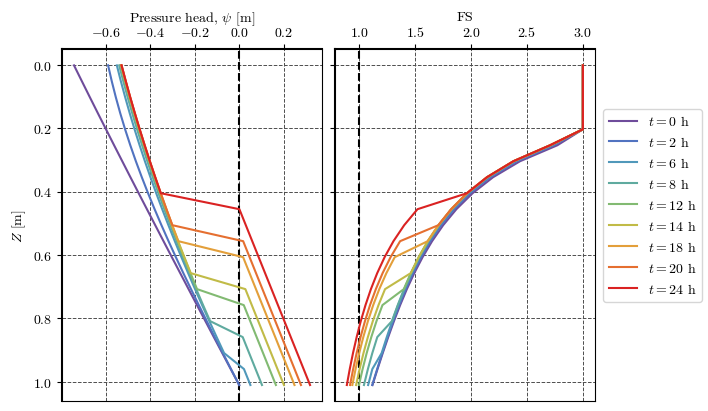
- Baum, R. L., Savage, W. Z., & Godt, J. W. (2002). TRIGRS—A Fortran Program for Transient Rainfall Infiltration and Grid-Based Regional Slope-Stability Analysis, Open file report 02-424 (p. 25) [Techreport]. U.S Geological Survey. 10.3133/ofr02424
- Baum, R. L., Savage, W. Z., & Godt, J. W. (2008). TRIGRS — A Fortran Program for Transient Rainfall Infiltration and Grid-Based Regional Slope-Stability Analysis, Version 2.0 (p. 75) [Techreport]. U.S Geological Survey. 10.3133/ofr20081159
- Alvioli, M., & Baum, R. L. (2016). Parallelization of the TRIGRS model for rainfall-induced landslides using the message passing interface. Environmental Modelling & Software, 81, 122–135. 10.1016/j.envsoft.2016.04.002